
Darkness as Historical Reversal
Heart of DarknessThis flow follows the darkness motif from the Thames and Roman Britain to the Congo and back to Europe.
increasing Bearing strength in each event
 decreasing
Bearing strength in each eventdecreasingThe Thames as Dark Place
A Familiar River Reframed
Imperial Memory
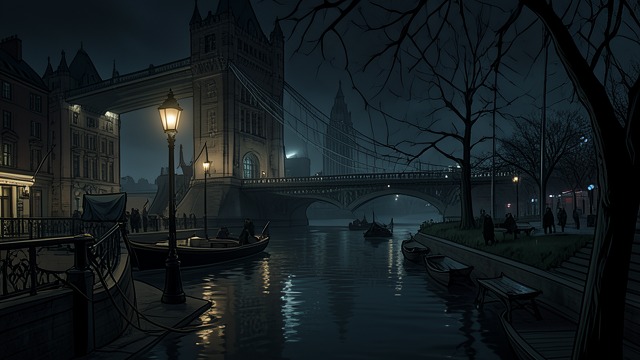
The Thames initially appears as a waterway carrying the memory of celebrated ships and national enterprise. Its history invites pride in exploration and expansion.
Marlow’s Reversal
Marlow calls it one of the dark places of the earth. The remark makes darkness a feature of history and power, not merely a distant landscape.
Home Is Not Exempt
The Thames becomes connected to the river Marlow will travel in Africa. Darkness can therefore return to the centre of imperial life rather than remain safely abroad.
Romans in Britain
Empire Reversed
The Earlier Conquest
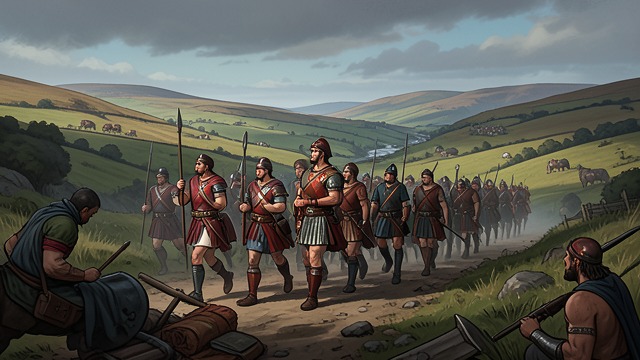
Marlow imagines Roman soldiers entering Britain as strangers. For them, the land would have seemed hostile and incomprehensible.
A Change of Perspective
The comparison makes Britain’s own imperial history resemble the African expedition. What later generations call civilization once appeared as invasion to people already living there.
The Recurring Pattern
Marlow’s historical analogy challenges any claim that conquest belongs only to distant places. Empire moves through time and can be judged from either side of its encounters.
The River’s Interior
Entering a Dark World
The Landscape Closes
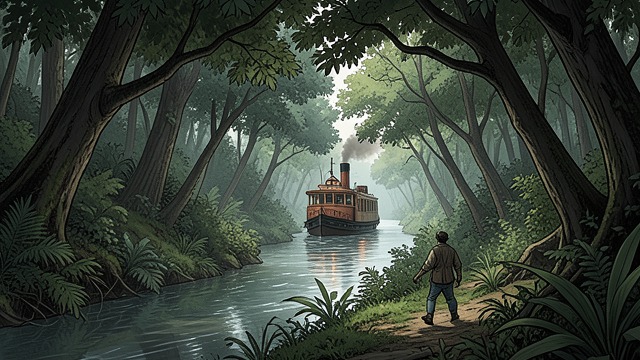
The river narrowed through dense forest and silence. The steamer seemed small against the immense vegetation and uncertain waterway.
Psychological Pressure
Marlow felt observed by a stillness that seemed to conceal an intention. His practical work kept him moving, but did not remove the sense of threat.
A Human Question
The river journey gradually made Marlow question the boundary between civilized conduct and supposedly primitive life. Darkness came to describe a moral possibility within human beings, not only a place.
Kurtz’s Inner Night
The Darkness Within
A Visible Atrocity
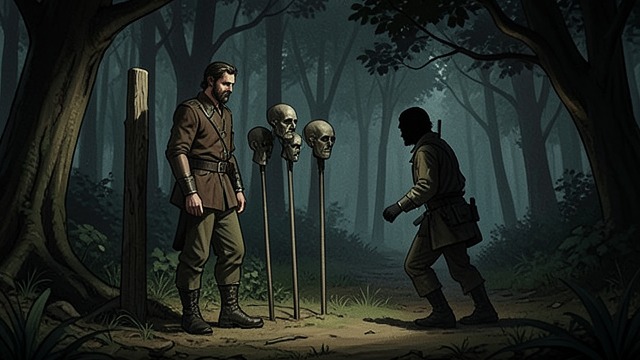
The heads on stakes showed that Kurtz’s rule had become violent and unrestrained. The evidence contradicted the humanitarian image attached to his name.
Solitude’s Exposure
Marlow believed the wilderness had forced Kurtz into an encounter with himself. Without ordinary checks, Kurtz’s appetite and vanity had grown into authority.
No Simple Otherness
The horror lay partly in recognizing human capacity in a figure formed by European ideals. Darkness could not be confined to the people the colonizers named savage.
The Return Under Clouds
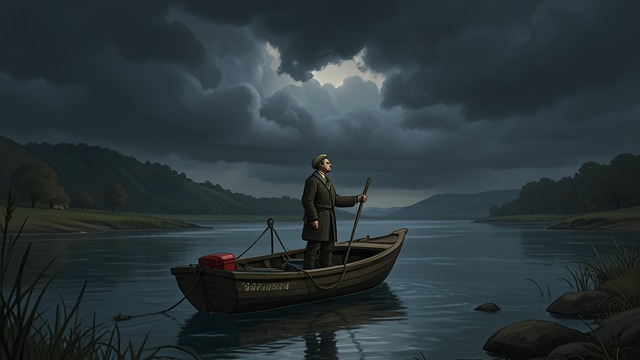
Darkness Comes Home
The Frame Returns
Marlow’s story ends aboard the Nellie on the Thames. The listeners face the familiar river again after hearing what happened inland.
A Changed Waterway
Clouds darken the estuary, making it seem to lead toward an immense darkness. The closing landscape refuses to separate London from the story’s moral concerns.
A Historical Continuity
The ending joins imperial past, African exploitation, and European memory. Darkness persists not as a solved mystery but as an unfinished judgment on the world that produced it.
At dusk on the Nellie
Marlow’s opening historical reflection
During Marlow’s upstream voyage
After Marlow discovers the posts near Kurtz’s house
After Marlow completes his tale
